Marks Don't Show This: 5 Thinking Skills Every Child Needs Beyond the Report Card
July 22, 2026 · 8 min read · Thinking & Problem Solving
Parents want to understand which important abilities may not appear clearly in marks or conventional report cards. They also want practical ways to recognise and support these skills at home.
Marks Don't Show This: 5 Thinking Skills Every Child Needs Beyond the Report Card
Quick Summary
Marks show performance in assessed subjects, but not every ability a child uses in life.
Five important life skills are sequencing, cause-and-effect reasoning, communication, emotional understanding, and problem solving.
Parents can observe these skills through stories, routines, conversations, and small responsibilities.
Progress may appear as clearer explanations, thoughtful choices, or greater independence - not only higher scores.
A report card may tell you what your child scored, but not whether your child can explain an idea, organise events, understand why something happened, consider another person's feelings, or solve an everyday problem. Marks are useful, but they offer only one view of learning. Children also need thinking, communication, and life skills that help them use knowledge beyond a worksheet. This article explains five such skills, what they look like in children aged 4-10, and how parents can strengthen them through ordinary conversations, stories, routines, and play.
Marks Matter - but They Are Not the Full Picture
A test may show whether a child remembered a fact, understood a lesson, or followed a familiar procedure. It may not reveal how the child approaches an unfamiliar situation. Can they explain their reasoning, recover when the first idea fails, understand another viewpoint, or complete a routine independently?
This is not an argument against marks or schools. Academic feedback helps parents and teachers identify strengths and learning gaps. The concern begins only when a number becomes the entire definition of the child.
India's National Curriculum Framework for the Foundational Stage calls for holistic development across academic and non-academic capacities. It includes communication, cooperation, resilience, conceptual understanding, problem solving, creativity, and critical thinking - not only learning for examinations.
A 2021 US survey of 2,000 parents by the Thomas B. Fordham Institute found that parents responded most positively to the term "Life Skills," while "Social-Emotional Learning" received much weaker support. The survey does not represent Indian parents, but it offers a useful communication lesson: practical descriptions often connect better with families than abstract educational labels. (Fordham Institute)
What Do Life Skills Look Like in a Child?
For a child aged 4-10, life skills may appear when they:
remember the steps for getting ready for school;
explain why someone slipped after water was spilled;
tell a grandparent what happened during the day;
try another method when a block structure falls;
predict what may happen if a plant is not watered.
These ordinary moments show how children observe, connect, communicate, and act.
Five Thinking Skills Beyond the Report Card
1. Sequencing: Organising Ideas and Actions
Sequencing is the ability to understand what comes first, next, and last. It supports storytelling, brushing teeth, packing a school bag, writing a paragraph, and solving a maths problem step by step.
A child developing this skill may say:
"First we mixed the batter, then Amma heated the pan, and finally we made the dosa."
Notice whether the child can identify a beginning, connect the middle steps, and recognise the result.
2. Cause-and-Effect Reasoning: Understanding Why
Cause-and-effect reasoning connects an action or event with its result:
"The toy broke because someone stepped on it."
"The plant grew because it received water and sunlight."
This skill supports safety, comprehension, science learning, and decision-making. Ask, "What makes you think that?" or "Could there be another reason?" The goal is thoughtful reasoning, not always one expected answer.
3. Communication and Storytelling: Making Thinking Visible
A child may know more than they can show in a written response. When children describe a picture or retell an event, they practise vocabulary, sentence formation, sequencing, memory, and clarity.
The National Curriculum Framework identifies effective communication for day-to-day interactions as a foundational goal and gives importance to oral-language development.
Instead of asking only, "Did you understand?", try:
"Tell me what happened in your own words."
"Which part was important?"
"How would you explain this to Ajji?"
The explanation helps you see how the child organises knowledge.
4. Emotional Understanding: Seeing Another Perspective
Children need opportunities to recognise what people may feel, want, or misunderstand. A child practising emotional understanding might notice that a sibling is disappointed after losing a turn or that two story characters may see the same event differently.
Stories create a safe distance for questions such as:
"How might this character feel?"
"Why might the other child disagree?"
"What could they say instead?"
The National Curriculum Framework describes stories as a way to explore social relationships, ethical choices, emotions, language, and life skills.
5. Problem Solving: Choosing What to Do Next
Problem solving appears when a child works out how to share limited crayons, rebuilds a fallen tower, finds a missing item, or cleans a spill safely.
It does not mean finding an answer immediately. It involves understanding the problem, considering options, trying a strategy, and checking the result. The National Curriculum Framework describes a similar process and encourages children to consider more than one strategy.
Parents can ask:
"What is the problem?"
"What could you try first?"
"Did that work?"
"What else could you do?"
Five Ways to Build These Skills at Home
1. Ask for the Thinking Behind an Answer
After homework, ask, "How did you work it out?" A child's explanation may reveal good reasoning even when there is a calculation or spelling mistake.
2. Give Small, Real Responsibilities
Let children pack part of the school bag, arrange items for puja, set the table, sort laundry, or prepare ingredients for a snack. Discuss the order and how they will check the task.
3. Discuss Everyday Cause and Effect
Ask what happens if wet clothes remain folded, toys block a doorway, ice is left outside, or diyas are placed carelessly. Keep the tone curious rather than corrective.
4. Use Stories Without Turning Them Into Tests
After a story, ask one thoughtful question:
"Why did the character choose that?"
"What would you have done?"
"Could the story end differently?"
Several answers may be reasonable.
5. Name the Progress You Notice
Instead of only saying, "Good job," try:
"You explained every step clearly."
"You thought of two solutions."
"You noticed how the other child might feel."
Specific feedback shows the child what successful thinking looks like.
Age-Wise Guidance
Ages 4-5
Look for simple three-step sequences, basic feeling words, short explanations, and attempts to solve familiar problems. Use pictures, pretend play, and household routines. Accept brief answers and model slightly fuller ones.
Ages 6-7
Children can begin explaining causes, retelling a story with a clear order, following longer instructions, and comparing two choices. Ask them to explain their reasoning before correcting the result.
Ages 8-10
Children can consider multiple causes, support an opinion with evidence, plan a task, reflect on mistakes, and recognise different perspectives. Encourage them to compare strategies and predict consequences.
A Screen-Free Way to See Thinking in Action
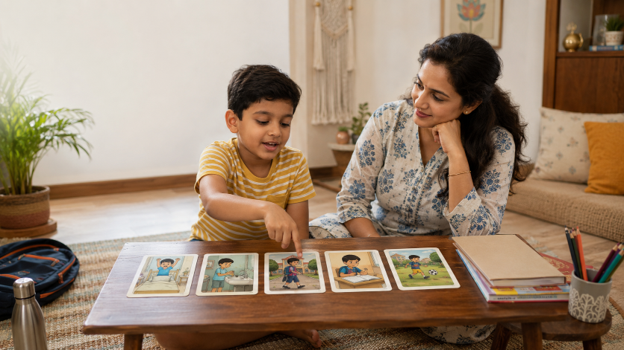
Picture-based activities make a child's thinking visible. Children can observe details, arrange events, explain choices, predict outcomes, and discuss feelings without facing a formal test.
LernZeit Creations' Storytelling & Sequencing Flashcards use five-card story sets for this kind of parent-child interaction. A child can place events in order, narrate the story, explain why something happened, describe how a character may feel, and suggest what could happen next.
This makes the cards more than a storytelling activity. They can help parents observe sequencing, communication, cause-and-effect reasoning, emotional understanding, and problem solving together.
There is no need for one perfect narration. The value lies in the conversation and in noticing how the child's explanations develop. The cards are one playful, screen-free tool alongside shared reading, household responsibilities, outdoor observation, and family storytelling.
Frequently Asked Questions
Does a High-Scoring Child Still Need Life-Skills Practice?
Yes. Academic performance and everyday thinking overlap, but they are not identical. A child may perform well in familiar tests and still need practice explaining choices, managing routines, considering feelings, or approaching unfamiliar problems.
Should Parents Formally Assess These Skills?
Usually, no score sheet is needed. Observe the child across different situations and notice gradual changes in clarity, independence, flexibility, and reasoning. Avoid comparing siblings.
What If My Child Gives an Unexpected Answer?
Ask for the reasoning before correcting it. The answer may be imaginative or logically possible from a different interpretation. Correct factual or safety misunderstandings gently while preserving the child's willingness to think aloud.
Key Takeaways
Marks provide useful information, but they do not represent every part of development.
Sequencing, reasoning, communication, emotional understanding, and problem solving are practical life skills.
Parents can observe these abilities during routines, stories, responsibilities, and conversations.
Questions such as "Why?", "What happened next?", and "What else could you try?" make thinking visible.
Progress can appear as clearer explanations, stronger reasoning, and growing independence.
References
National Council of Educational Research and Training.National Curriculum Framework for the Foundational Stage 2022. The framework discusses holistic development, communication, critical thinking, life skills, storytelling, reasoning, and problem solving.
Tyner, Adam.How to Sell SEL: Parents and the Politics of Social-Emotional Learning. Thomas B. Fordham Institute, 2021.
Northern, Amber M., and Michael J. Petrilli.The Vast Majority of Parents Want Schools to Teach Children Social and Emotional Skills. Thomas B. Fordham Institute, 2021. (The Thomas B. Fordham Institute)